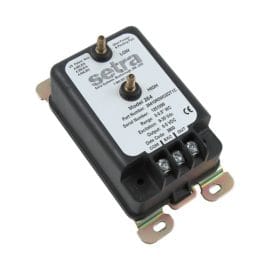
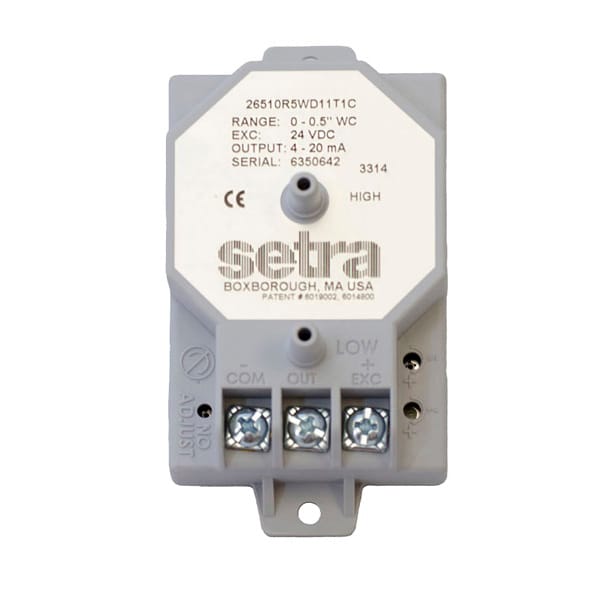
The Setra Model 265 is built for very low differential pressure measurement, the kind of job where a small draft or pressure difference between two spaces really matters. In actual application, this is the instrument we see specified for cleanrooms, fume hood monitoring, isolation rooms, and general HVAC pressure control, where the pressure difference being watched might only be a few Pascals.
It uses an all stainless steel capacitive sensing element inside a fire retardant, glass-filled polyester case (UL 94-V approved), so it holds up well in a typical mechanical room or duct environment. Standard accuracy is ±1.0% FS, with tighter ±0.4% FS and ±0.25% FS options available if the application calls for it. Output is a straightforward 4-20mA 2-wire loop, or 0-5VDC/0-10VDC on 3-wire, powered by 24VDC or 24VAC excitation (it will accept 9-30VDC or 9-30VAC in practice). Temperature compensated range is -18°C to +65°C, and it can take overpressure up to about 10 PSI (roughly 70kPa) depending on the range ordered, so a transient pressure spike on the line will not damage the sensor.
From our experience, this model gets specified whenever someone needs to confirm a room is holding negative or positive pressure relative to its neighbour, not just switch a fan on or off. Before we quote this, we would normally check whether unidirectional or bidirectional range is needed, which accuracy class, and 2-wire or 3-wire output, since this unit covers a wide spread of ranges, from as low as 0-25 Pa up to 0-1000 Pa unidirectional, or ±25 Pa to ±1000 Pa bidirectional. Hope this helps.