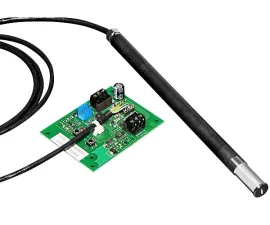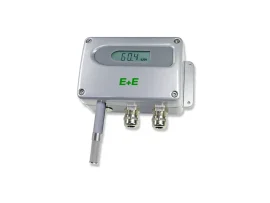
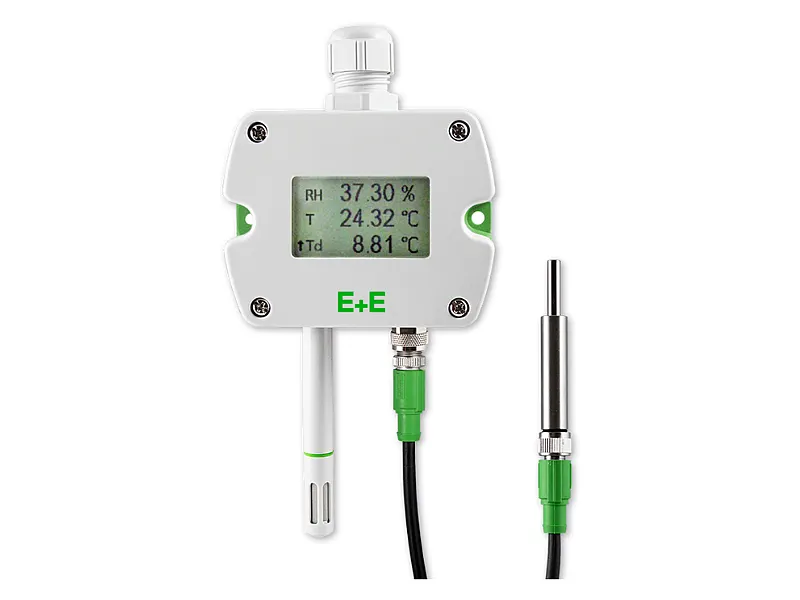
E+E EE211 Humidity and Temperature Sensor for Continuous High Humidity
Cold stores, ripening chambers and greenhouses run at high humidity around the clock, a tough environment for standard sensors. The E+E EE211 uses a heated humidity probe and a separate, interchangeable temperature probe to keep measuring reliably in these condensing conditions.
How It Works
Heating the humidity probe keeps it free of condensation. The measurement electronics are completely encapsulated inside the humidity probe, and the long-term stable HCT01 sensing element is protected by the E+E proprietary coating, so the EE211 also performs well in polluted, aggressive atmospheres.
Key Features
- Heated humidity probe for condensing environments
- Interchangeable temperature probe
- HCT01 sensing element with E+E proprietary coating
- IP65 / NEMA 4 enclosure
- All values on Modbus RTU; two values on analogue voltage or current (3-wire) output
- Optional illuminated display showing up to three values
- One- or two-point RH and T adjustment via optional USB configuration adapter
Applications
- Fruit and vegetable storage
- Cooling, ripening and environmental chambers
- Greenhouses and incubators
- Mushroom growing
Industries Served
- Agriculture and horticulture
- Food storage and cold chain
- Environmental testing
Frequently Asked Questions
Why does the EE211 use a heated probe?
Heating the humidity probe prevents condensation on it, so measurement stays reliable in continuously high humidity.
Which interfaces does the EE211 offer?
Modbus RTU for all measured and calculated values, plus two analogue voltage or current outputs.
Need help choosing the right E+E EE211 configuration? Contact Celectric for a quotation, datasheet and technical support in Malaysia.