We had an enquiry from a customer whose control system needed to track a fast-changing current signal from a test rig. The standard isolator they had been using was smoothing over the fast transients they actually needed to capture.
This looks simple, but most general-purpose signal isolators have a response time in the tens or hundreds of milliseconds, which is more than fast enough for slow process variables like temperature or level, but far too slow for dynamic signals that change in microseconds. If you pick a standard isolator for a fast-moving signal, you don’t get an error message — you just get a smoothed, delayed version of the real signal, which can be worse than no isolation at all if you’re trying to catch transient events.
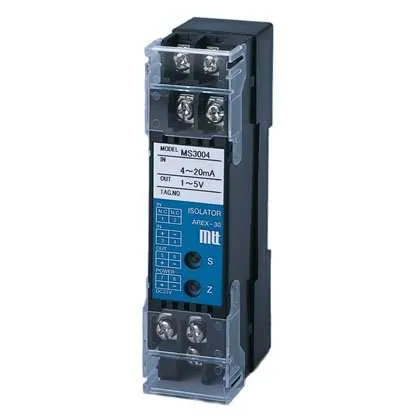
For this, we would normally recommend the MTT MS3044, a terminal block type high-level signal conditioner built specifically for fast response. It accepts a wide range of DC current or voltage inputs and re-issues them as a clean, isolated DC output with a response time of 70 microseconds and a 10kHz frequency response, fast enough to track dynamic signals that a standard conditioner would smooth over. Isolation between input, output, and power still applies, so you get the ground loop and noise protection of a normal isolator without giving up speed. It mounts on DIN rail right where the field wiring lands, with front-accessible zero and span trimmers for quick on-site calibration.
Before we quote, we would normally check the exact input signal range and how fast the signal actually needs to be tracked, since the standard MS3004 is a more economical choice if your application doesn’t need this level of speed. Hope this helps — send us your signal details and we can confirm the right model.
| Input Types | DC current (100µA to 200mA) or DC voltage (200mV to 600V) |
| Input Options | 0-20mA, 2-10mA, 1-5mA, 4-20mA, 10-50mA; 0-1V, 0-10V, 0-5V, 1-5V, ±5V, ±10V |
| Output Signal | -10 to 10V DC (span 10mV to 20V) |
| Zero / Span Adjustment | ±2.5% of span each |
| Accuracy | Better than ±0.1% of span (at 25°C±5°C) |
| Response Time | 70µs max. (0 to 90%), 10kHz -3dB frequency response |
| Temperature Effect | ±0.2% of span per 10°C change |
| CMRR | 100dB min. (500V AC, 50/60Hz) |
| Power Supply | 24V DC ±10% |
| Power Consumption | 30mA max. |
| Isolation | 3-way isolation between input, output, and power |
| Insulation Resistance | 100MΩ min. (@ 500V DC) |
| Dielectric Strength | 1500V AC for 1 minute |
| Surge Withstand | Tested per ANSI/IEEE C37.90.1-1989 |
| Enclosure / Mounting | ABS resin (UL 94V-0), DIN rail mounting, M3.5 screw terminal |
| Dimensions | W25.0 × H94.0 × D40.0 mm |
| Weight | 90g max. |
| Operating Temperature | -5 to 55°C, 5-90% RH non-condensing |
| Storage Temperature | -10 to 60°C |
Frequently asked questions
What is the MS3044 used for?
It isolates and converts a fast-changing DC current or voltage signal, holding a 70 microsecond response time so dynamic signals aren’t smoothed over the way they would be by a standard isolator.
What’s the difference between the MS3044 and the MS3004?
The MS3004 has a standard response time of 85ms (10ms with the /K fast-response option), while the MS3044 is built specifically for fast-response applications, with a response time of 70 microseconds. If your loop needs very fast signal tracking, the MS3044 is the better fit; otherwise the MS3004 is the more economical choice.
Does the MS3044 need a separate power supply?
Yes, it runs on 24V DC only and is not loop-powered.
Can the MS3044 be used for general-purpose signal isolation?
Yes, but if your application doesn’t need microsecond-level response, the standard MS3004 covers most general isolation needs at a lower cost.
Download MTT MS3044 Terminal Block Type High-Level Signal Conditioner (Fast Response Model) information here
Datasheet: MTT MS3044 Spec Sheet (PDF)
Manual: MTT MS3000 Series User’s Manual (PDF)