We had an enquiry from a vector motor OEM who kept losing encoders to what looked like electrical damage – pitting on the bearings and occasional erratic signal, even though the mechanical installation looked fine. This is a classic symptom of shaft currents from the motor’s drive electronics finding a path through the encoder.
This looks simple, but on a vector-duty motor, stray electrical currents can travel down the motor shaft and through anything mounted on it, including the encoder. If the encoder’s hollow shaft isn’t electrically isolated from the motor shaft, those currents pass through the encoder bearings over time and slowly destroy them – which is often mistaken for a mechanical or vibration problem.
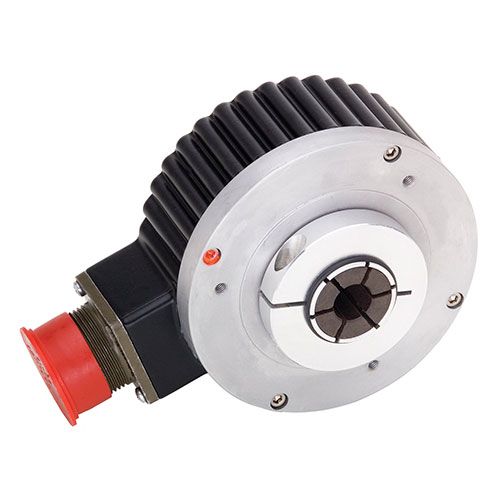
In actual application, the Hengstler HSD38 is built specifically to solve this. It’s a harsh-duty hollow-shaft optical encoder with an electrically and thermally isolated hollow shaft (bore size 12mm up to 1″/25.4mm), so shaft currents from the motor don’t pass through the encoder. It has a dual-sealed housing, IP67 rated, and is independently validated to 400G shock and 20G vibration – it’s a common choice for vector motor OEMs for exactly this reason. Resolution runs from 15 up to 5,000 PPR, supply voltage is 5-26VDC with Open Collector, Push-Pull, or DLD 7272 output, and operating temperature is -40°C to +100°C. There’s also an intrinsically safe ATEX version available when paired with the correct IS barrier, for classified hazardous areas.
From our experience, before we quote this, we would normally check the exact bore size, resolution (PPR), output type, and whether shaft/bore electrical isolation is confirmed as a requirement (as opposed to the HSD37, which is similar but not isolated in the same way). Hope this helps.