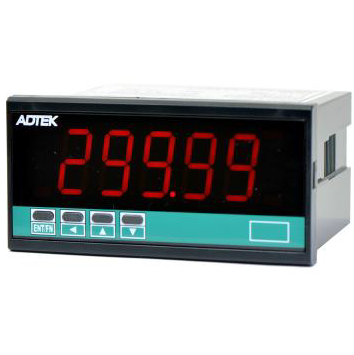
We had an enquiry from a customer with a low-level DC millivolt signal – the output from a shunt resistor – who needed a panel meter to show the reading locally and also send it on as an analogue signal to their PLC. A standard voltage meter wasn’t giving them a stable reading, because the signal was too small for the range it was set to.
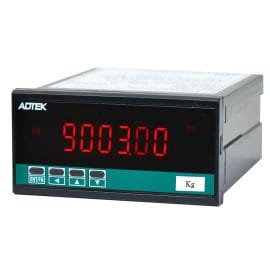
This looks simple, but the ADtek CS1 series is built with a specific order code for exactly this reason. The CS1-VA-DVB-V-A breaks down as: D (DC measuring), VB (0~60mV input range), V (0(1)~5V or 0~10V analogue output), A (AC115/230V auxiliary power). The “VB” range is the important part here – it’s built for a signal in the tens of millivolts, with high input impedance (5MΩ or better) so it doesn’t load down a weak source. Order the wrong range code and the meter either can’t resolve a small mV signal properly, or clips a larger one.
In actual application, the CS1-VA-DVB-V-A gives 16-bit A/D resolution with DC accuracy of ≤0.04% of full scale, a 15 cycles/second sampling rate, and response time of 100ms or better. It retransmits the reading as a 0(1)~5V or 0~10V analogue signal, so your PLC or DCS can read it alongside the local panel display. It runs off standard AC115/230V, no separate DC supply needed.
From our experience, before we quote this, we would normally check the actual mV signal level and source you’re measuring (to confirm the 0~60mV range is correct for your application), and whether you need the analogue output as specified or would prefer a relay or RS-485 option instead – ADtek offers all three on this same base unit. Hope this helps.