
We recently received an enquiry from a facilities team in Penang whose VAV boxes kept losing balance a few months after commissioning — one zone running too cold, another barely getting airflow, and the BMS graphs showing static pressure readings that didn’t match what the technician measured on-site with a handheld manometer. Their first instinct was to blame the controller programming. After some back and forth, the actual root cause turned out to be the differential pressure transducer itself.
Root Cause: Sensor Drift Isn’t Always Obvious
A differential pressure transducer doesn’t usually fail outright — it drifts. Zero and span shift over time due to temperature swings in the ceiling void, small amounts of moisture or dust ingress at the tubing ports, or simply age beyond the sensor’s rated stability window. Once that happens, the BMS is making control decisions based on a number that no longer reflects the actual duct condition. The damper keeps “chasing” a setpoint it can never quite reach, the VAV box hunts, and depending on which direction the drift goes, you either get an energy-wasting overventilated zone or an undercooled one that generates complaints.
In actual site conditions here in Malaysia, we also see a second contributor: tubing runs that pick up condensation in humid ceiling spaces, which adds a pressure offset that has nothing to do with sensor accuracy at all — worth ruling out before you condemn the transducer.
Practical Installation & Spec Considerations
Before issuing a PO for a replacement transducer, it’s worth checking a few things on site:
- Confirm which accuracy class you actually need. The Setra 264 is available in ±1.0% FS (standard), ±0.4% FS, and ±0.25% FS — a general HVAC duct static application rarely needs the tightest class, but a fume hood or cleanroom pressure-control loop usually does. Buying tighter accuracy than the application calls for is money spent for no operational benefit.
- Match the range to the actual expected differential, not the nearest “round number” range you have in stock. An oversized range compresses your live signal into a small part of the transducer’s output span, which itself looks like poor accuracy even when the sensor is fine.
- Check the tubing and fittings for moisture pooling, especially on ceiling-void installations — a physical trap in the line will show up as a pressure error that no amount of sensor recalibration will fix.
- The 264 ships with a 3-year unconditional warranty and reverse-wiring protection, which is worth factoring in if you’re comparing it against a cheaper alternative that doesn’t carry the same terms — the total cost of a callback visit usually erases any saving on the unit price.
Before You Call Us
If your VAV zones are drifting and you’ve already ruled out a programming issue, send us the current transducer’s range and accuracy label (usually printed on the terminal side of the unit) along with a rough description of the duct static range you’re targeting. We can tell you fairly quickly on a call whether a straight like-for-like replacement makes sense, or whether the original spec was wrong for the application to begin with — no obligation either way.
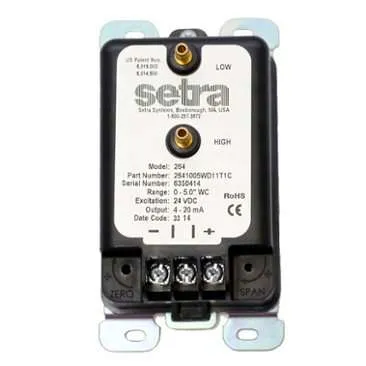
Setra 264 Low Differential Pressure Transducer
Very low differential pressure transducer for building energy management
