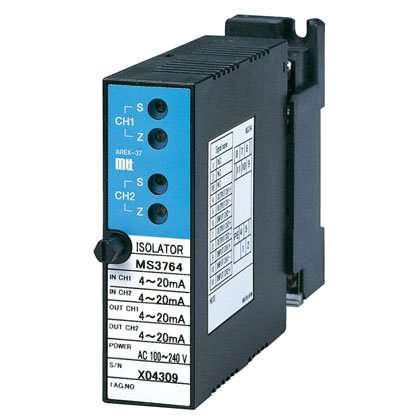
The MTT MS3764 Slim Plug-In 2-Channel Loop-Powered Isolator draws its operating power directly from the 4-20mA current loop it is monitoring, so it can be installed without running a separate power supply to the panel. Two independent isolated channels are built into a single slim housing, letting one module isolate two current loops side by side and making efficient use of panel space in installations that need to break ground loops on multiple field signals at once.
Because it takes its power from the loop itself, the MS3764 is especially useful in retrofits and remote locations where adding AC or DC power wiring would be costly or impractical. Front-accessible trimmers allow zero and span to be adjusted on site, and channel-to-channel isolation keeps each loop electrically independent so that noise or a fault on one channel cannot propagate to the other. Its fast response and tight accuracy make it well suited to isolating signals feeding safety, control, or monitoring instrumentation that cannot tolerate lag or drift.
| Input Signal | 4 to 20mA DC |
| Input Resistance | Approx. 250Ω at 20mA DC input (voltage output model); approx. 230Ω plus load resistance at 20mA DC (current output model) |
| Max Input Current | 30mA DC |
| Output (Voltage Model) | 1 to 5V DC, 50kΩ min. load |
| Output (Current Model) | 4 to 20mA DC, 350Ω max load (50-350Ω allowable range) |
| Zero Adjustment | ±2.5% span (voltage); ±0.5% span (current) |
| Span Adjustment | ±2.5% span (voltage); ±1.5% span (current) |
| Accuracy | Better than ±0.15% of span |
| Temperature Coefficient | Better than ±0.2% per 10°C change |
| Response Time | 15ms max (0-90%, step input at 100%) |
| CMRR | 100dB min. (500V AC, 50/60Hz) |
| Isolation | 100MΩ min. insulation resistance @500V DC; 1500V AC dielectric strength for 1 minute (input/output and channel-to-channel) |
| Surge Protection | Tested per ANSI/IEEE C37.90.1-1989 |
| Power | Loop-powered — draws operating power directly from the input current loop, no external power supply required |
| Dimensions | W29 x H86 x D125mm |
| Weight | 100g (main unit) / 80g (socket) |
| Terminals | M3.5 screw terminals with cover and drop-out screws, 0.8-1.0 Nm torque |
| Mounting | Wall or DIN rail mount |
| Operating Conditions | -5 to 55°C, 5-90% RH non-condensing |
| Storage Temperature | -10 to 60°C |
| Additional Features | Load change compensation circuit (current output models); dual-channel isolation |
Frequently Asked Questions
What is the MTT MS3764 used for?
It’s a slim plug-in 2-channel loop-powered isolator that draws its operating power directly from the 4-20mA current loop it’s monitoring, so it can be installed without running a separate power supply to the panel. Two independent isolated channels are built into one slim housing, letting a single module isolate two current loops side by side.
Do I need a separate power supply for this unit?
No. Since it’s loop-powered, it takes its operating power from the 4-20mA signal itself, which makes it especially useful in retrofits and remote panel locations where running new power wiring is impractical or expensive.
What input and output signal types does it accept?
Input is a standard 4-20mA DC loop signal. Output is available as either a voltage model (1-5V DC, 50kΩ min. load) or a current model (4-20mA DC, 350Ω max load). Tell us which output type your downstream equipment needs.
Can I fine-tune the zero and span after installation?
Yes, both are adjustable, ±2.5% span for zero and span on the voltage model, and ±0.5%/±1.5% span on the current model, so the output can be matched to the receiving instrument on site.
How do I know if the MS3764 is right for my application?
If you need to break a ground loop or isolate two 4-20mA current loops without running new power wiring to the panel, the MS3764 handles both channels in a single compact unit. Send us your output type preference (voltage or current) and we can confirm before you order.
Download MTT MS3764 Slim Plug-In 2-Channel Loop-Powered Isolator information here
Spec Sheet: MTT_SpecSheet1_MS3764_Rev220_E
Manual: MTT_Manual1_MS3764_Rev140_E