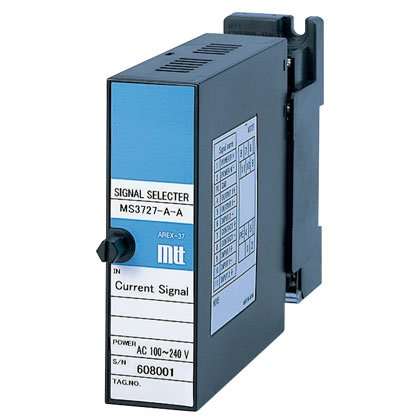
The MTT MS3727 is a slim plug-in signal selector that switches between two DC input signals on command from a dry contact, rather than choosing automatically like a high/low comparator. Close the contact and Input 1 passes through to the output; open it and the unit switches to Input 2. That makes it a simple way to bring a manual or interlocked override into a signal path, such as switching between a live sensor and a fixed test signal, or toggling between two transmitters from a remote switch.
It accepts current or voltage inputs directly, or current signals through a shunt resistor, and switches in as little as 5ms. Like the rest of the plug-in transmitter series, the MS3727 clips into its own socket base for fast swap-out during calibration or maintenance without disturbing the field wiring, and flexible AC or DC power plus wall or DIN rail mounting make it easy to fit into an existing panel.
| Input Channels | 2 (Input 1, Input 2) |
| Input Signal | DC current (±50mA max.) or DC voltage (±50V max.); current via 50Ω shunt resistor option |
| Minimum Span | 1mA DC (current) or 10mV DC (voltage) |
| Switching Input | Dry contact, internal 24V DC pull-up at 10mA; closed = Input 1, open = Input 2 |
| Output | Equivalent to the selected input signal level |
| Accuracy | ±0.1% (shunt resistor configuration) |
| Temperature Effect | ±0.25ppm/°C |
| Response Time | 5ms max. |
| Internal Resistance | 50Ω max. per wire |
| Isolation | 4-way isolation between input/output, switching input, power, and ground |
| Insulation Resistance | 100MΩ min. at 500V DC |
| Dielectric Strength | 2000V AC for 1 minute |
| Power Supply | 100-240V AC (3.5VA max.), 24V DC (0.6W max.), or 100-240V DC (6.0W max.) |
| Dimensions | W29 × H86 × D125mm |
| Weight | 120g max. (main unit), plus 80g max. socket |
| Mounting | Wall or DIN rail mounting |
| Terminals | M3.5 screw terminals, 0.8-1.0 Nm torque |
| Operating Temperature | -5 to 55°C |
| Operating Humidity | 5 to 90% RH, non-condensing |
Frequently Asked Questions
What is the MTT MS3727 used for?
It switches between two DC input signals on command from a dry contact — close the contact and Input 1 passes through, open it and it switches to Input 2. It’s a simple way to bring a manual or interlocked override into a signal path, such as switching between a live sensor and a test signal.
What’s the difference between the MS3727 and the MS3725 high/low selector?
The MS3725 automatically compares two signals and passes through whichever is higher or lower. The MS3727 doesn’t compare — it switches between the two inputs only when you tell it to, via a dry contact. Use the MS3725 for automatic redundant-sensor selection, and the MS3727 when you need manual or interlock-driven switching.
What kind of switching input does the MS3727 need?
A simple dry contact closure — the unit provides its own internal 24V DC pull-up at 10mA, so no external power is needed for the switching signal.
How fast does the MS3727 switch between inputs?
Switching takes 5ms max., so the output responds almost immediately to a change in the contact state.
How do I know if the MS3727 is right for my application?
If you need to manually or automatically switch a signal path between two sources using a simple contact closure, the MS3727 is built for that. Send us your two input signal types and we can confirm before you order.
Download MTT MS3727 Slim Plug-In Signal Selector information here
Spec Sheet: SpecSheet1_MS3727_Rev170_E.pdf
Manual: Manual1_MS3727_Rev150_E.pdf