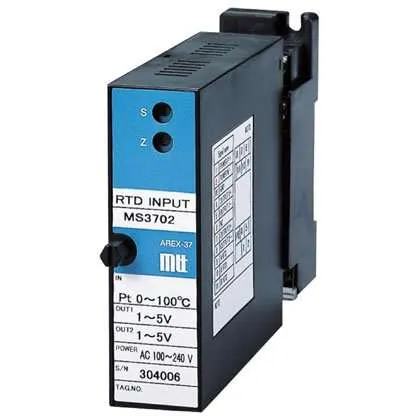
The MTT MS3702 is a slim plug-in RTD temperature transmitter, mounted on a plug-in base socket for quick swap-out without rewiring. It accepts Pt100Ω, JPt100Ω, Pt50Ω, Ni508.4Ω, or custom RTD types (range -200 to +850°C depending on type), with minimum input span of 30-100°C depending on RTD type. Excitation current is approximately 1mA for Pt type at 0-100°C, with lead wire resistance up to 200Ω max per wire.
Output is 0~20mA DC, 4~20mA DC, or 10mV to 20V DC span range, available as a single output or an isolated dual output, with output load up to 750Ω for a single 4~20mA output, or 550Ω (output 1) and 350Ω (output 2) when both are used. There is 4-way isolation between input, output, power, and ground.
Accuracy is better than ±0.15% of span (at 25°C±5°C), with temperature effect better than ±0.2% of span per 10°C change and response time of 170ms max (0-90%). CMRR is 100dB minimum (500V AC, 50/60Hz).
The unit mounts on wall or DIN rail via a plug-in socket base, with M3.5 screw terminals. Power supply is flexible: 100-240V AC, 24V DC, or 100-240V DC (approximately 5.5-7.0VA AC or 1.6-1.8W DC). Main unit weighs 120g and the socket 80g, with overall dimensions of 29mm × 86mm × 125mm. It is rated for -5 to 55°C ambient operation (-10 to 60°C storage) and 5-90% RH non-condensing.
| Input Types | Pt 100Ω, JPt 100Ω, Pt 50Ω, Ni 508.4Ω, or custom (range -200 to +850°C depending on type) |
| Minimum Input Span | 30-100°C depending on RTD type |
| Excitation Current | Approximately 1mA for Pt type at 0-100°C |
| Lead Wire Resistance | 200Ω maximum per wire |
| Output | 0-20mA DC, 4-20mA DC, or 10mV to 20V DC span range (single or isolated dual output) |
| Output Load (Current) | Single 4-20mA: max 750Ω; dual outputs: max 550Ω (Output 1), 350Ω (Output 2) |
| Isolation | 4-way isolation between input, output, power, and ground |
| Power Supply | 100-240V AC, 24V DC, or 100-240V DC (approx. 5.5-7.0VA AC or 1.6-1.8W DC) |
| Accuracy | Better than ±0.15% of span (at 25°C±5°C) |
| Temperature Effect | Better than ±0.2% of span per 10°C change |
| Response Time | 170ms maximum (0-90%) |
| CMRR | Minimum 100dB (500V AC, 50/60Hz) |
| Dimensions (W x H x D) | 29mm x 86mm x 125mm |
| Weight | Main unit 120g; socket 80g |
| Mounting | Wall or DIN rail mounting, plug-in socket base |
| Terminals | M3.5 screw terminals |
| Operating Temperature | -5 to 55°C ambient (storage: -10 to 60°C) |
| Operating Humidity | 5-90% RH, non-condensing |
| Standards | CE marked (EMC and Low Voltage Directives); Installation Category II, Pollution Degree 2 |
Frequently Asked Questions
What is the MTT MS3702 used for?
It converts an RTD (resistance temperature detector) signal into a standard 4-20mA, 0-20mA, or DC voltage output that a PLC, DCS, or panel meter can read directly.
Can the MS3702 be used with 2-wire, 3-wire, or 4-wire RTDs?
The MS3702 tolerates lead wire resistance up to 200Ω per wire. For the exact wiring configuration your sensor uses, we’d confirm the terminal connections against the manual before you order.
What’s the difference between the MS3702 and the MS3701 / MS3701F?
The MS3701 and MS3701F are thermocouple transmitters — they take a millivolt thermocouple input. The MS3702 is built for RTD (resistance) inputs instead. Match the transmitter to the sensor type you actually have.
What’s the difference between the MS3702, MS3702-01, and MS3702B?
These are variants within the same RTD transmitter family with different output or configuration options. If you’re replacing an existing unit, check the exact model code on the old unit’s label, or send us your input and output requirements and we’ll confirm the right variant.
How do I know which MS3702 model I need?
Check your RTD element type, whether you need single or dual isolated output, and the output signal your PLC or DCS expects. Send us these details and we can confirm the right model before you order.
Download MTT MS3702 Slim Plug-In RTD Temperature Transmitter information here
Spec Sheet: MTT MS3702 Spec Sheet
Manual: MTT MS3702 Manual