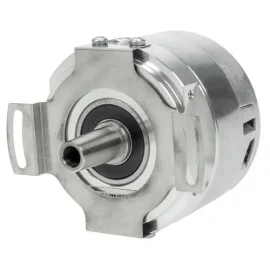
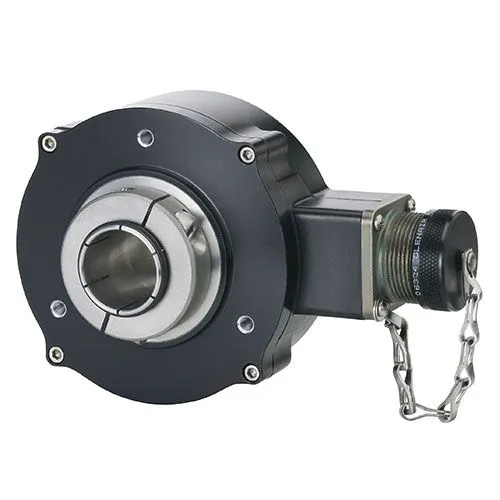
We had an enquiry from a customer on a drilling rig – a top drive/drawworks type application – who needed an encoder that could survive constant vibration, shock loading, and occasional wash-down with caustic cleaning chemicals. Standard shaft-mount encoders on this kind of equipment just don’t last.
This looks simple, but oilfield and heavy mill equipment like top drives, drawworks motors, rotary tables and mud pumps put encoders through a lot – constant vibration, shock loading, and in some cases corrosive wash-down. The encoder has to survive all of that while still giving a clean, reliable pulse signal for speed and position feedback.
In actual application, the Hengstler HSD37 is built for exactly this kind of extreme duty. It’s a hollow-shaft optical encoder with a double-sealed housing, IP67 rated, independently validated to 400G shock and 20G vibration. Hollow bore size runs from 6mm up to 1″ (25.4mm), with multiple tether options for mounting directly over the driven shaft. Housing is available in aluminum, nickel-plated, or stainless steel depending on the level of chemical/wash-down exposure. Resolution goes up to 20,000 PPR, dual isolated outputs are available for redundancy, supply voltage is 5-26VDC, and operating temperature is -40°C to +100°C. There’s also an intrinsically safe version certified to ATEX when paired with the correct IS barrier, for use in classified hazardous areas.
From our experience, before we quote this, we would normally check the exact bore size, housing material, resolution (PPR), whether dual isolated outputs are needed for redundancy, and whether the area is a classified hazardous location. Hope this helps.