
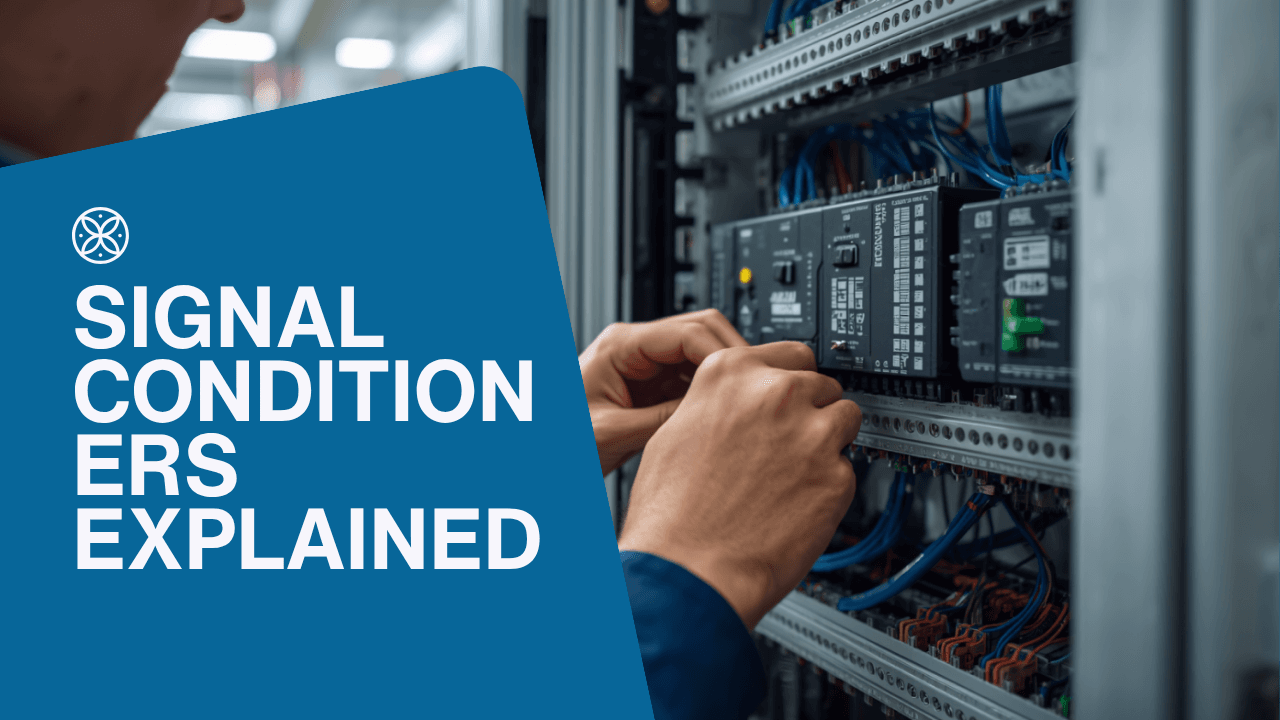
It’s one of the most common troubleshooting calls Celectric’s technical team gets: a sensor that reads perfectly fine on the bench, but noisy, unstable, or plain wrong once it’s wired into the actual plant. Nine times out of ten, the sensor isn’t the problem — the signal path between the sensor and the control system is. That’s exactly the gap a signal conditioner is designed to close.
What a Signal Conditioner Actually Does
A signal conditioner sits between the sensor and the control system, and typically performs one or more of these functions:
- Amplification — boosting a weak sensor signal to a usable level.
- Isolation — electrically isolating the sensor circuit from the control system to eliminate ground loops and protect equipment from transients.
- Filtering — removing electrical noise picked up along the cable run.
- Signal conversion — converting one signal type (e.g. a raw millivolt signal) into a standard industrial signal like 4-20mA.
- Linearization — correcting a sensor’s non-linear output into a usable straight-line signal.
Common Scenarios in Malaysian Manufacturing Plants
- Long cable runs — a sensor located far from the control panel picking up electrical interference from nearby motors, VFDs, or power cabling along the way.
- Ground loop issues — unstable or drifting readings caused by ground potential differences between the sensor location and the control panel.
- Mixed old and new equipment — a facility upgrading part of its instrumentation and needing to convert a legacy sensor’s output into a standard signal the newer control system can read.
- Harsh electrical environments — heavy machinery, welding equipment, or large motor starters nearby, all sources of the electrical noise a signal conditioner is built to reject.
How to Know If You Need One
A few practical warning signs that a signal conditioner (or a different one than what’s currently installed) might be the fix:
- Readings that fluctuate or “jump” without any actual process change.
- Values that change when nearby equipment (a motor, VFD, or welder) switches on.
- A sensor signal that reads correctly close to the source but degrades over a long cable run.
- Needing to connect a sensor with a non-standard output to equipment that only accepts 4-20mA or 0-10V.
Buying Through Celectric
Signal conditioners are one of Celectric’s largest product categories, reflecting how often this exact problem shows up across Malaysian manufacturing, utilities, and process industries. Our technical team can help diagnose whether a signal issue is coming from the sensor, the wiring, or the surrounding electrical environment — and recommend the right conditioning module for your specific case. Browse our signal conditioner range or contact us with your specific symptom and we’ll help troubleshoot it.
