
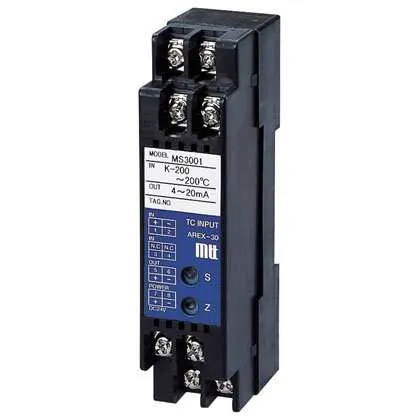
We had an enquiry from a customer who needed to wire a thermocouple into their PLC, but the raw millivolt signal coming off the thermocouple wasn’t something their controller could read directly, and on a long cable run they were also picking up noise and drift in the reading.
This looks simple, but before picking a part number we’d need a few details from you. Which thermocouple type are you using – K, J, E, T, B, R, S, or N – and over what temperature span? What output signal does your PLC or DCS actually accept – 4~20mA, 0~10V, or one of the other available ranges? And do you have 24VDC or 12VDC available to power it (the 12VDC version isn’t CE marked, worth knowing if that matters for your project)? The MTT MS3001 covers all 8 standard thermocouple types, but the exact order code depends on your specific input, output, and power combination.
In actual application, the MS3001 is a terminal block type transmitter that mounts on DIN rail right where your thermocouple wiring terminates, with input, output, and power fully isolated from each other – that isolation is what breaks ground loops and keeps electrical noise (from VFDs, welding equipment, etc.) from corrupting your reading. Cold junction compensation is built in, zero and span are field-adjustable so technicians can fine-tune on site, and if the thermocouple ever fails open, burnout protection drives the output to a safe, known state instead of an unpredictable one. Standard response time is 160ms; a high-speed 10ms version is also available if your process needs a faster reaction.
From our experience, before we quote this, we would normally check your thermocouple type, the temperature span you’re measuring, your required output signal, your available power supply, and whether you need the standard or high-speed response version. Hope this helps.


