
We had an enquiry from a customer running a wash-down area in a food processing line. Their existing encoder kept failing every few months, and after a bit of digging it turned out the encoder wasn’t rated for the caustic wash-down chemicals and high-pressure spray used to clean the equipment daily.
This looks simple, but a lot of standard encoders are only rated IP65 or so, which is fine for dust and light splashing but not for daily high-pressure wash-down with corrosive cleaning chemicals. Over time, moisture and chemicals work their way past the seals and the encoder gives up.
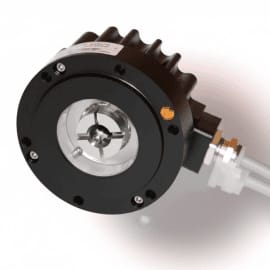
In actual application, the Hengstler HD20 is built specifically for this kind of harsh, corrosive environment. It carries an IP67 rating (to NEMA 6 enclosure requirements) and is available with a stainless steel, anodized aluminum, or nickel-plated housing, depending on how aggressive the wash-down chemicals are. It’s an optical incremental encoder with a 2.0″ flange, shaft or hollow-bore mounting (3/8″ or 10mm), resolution up to 20,000 PPR, and it runs on 5-26VDC supply with a choice of Open Collector, Open Collector with Pull-Up, Push-Pull, or DLD 7272 output. Operating temperature range is -40°C to +100°C. There is also a separate intrinsically safe ATEX/UL/IECEx version (the HD20 Hazardous series) for use in classified hazardous areas.
From our experience, before we quote this, we would normally check the exact housing material needed (stainless steel for the harshest wash-down environments), the resolution (PPR), shaft or hollow-bore size, output type, and whether the application is a classified hazardous area or not. Hope this helps.