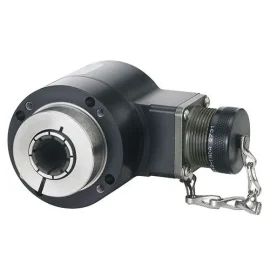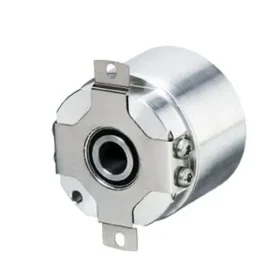

We had a similar enquiry to the AC59 – a customer with offshore/marine equipment needing a corrosion-resistant absolute encoder – but this time they also needed it to talk to their PLC over a fieldbus network rather than a simple cable connection.
This looks simple, but the AC61 supports a lot of different fieldbus and network options – SSI, BiSS, Profinet, Profibus, CANopen, CANlayer2, DeviceNet, EtherCAT and Interbus – and each one uses a different part number, datasheet and installation manual. Picking the wrong interface means it simply won’t talk to the rest of the system.
In actual application, the Hengstler ACURO AC61 is built with the same stainless steel housing as the AC59, for oil and gas, marine fittings, food industry, packaging and offshore applications like derrick cranes, winches and cable-laying equipment. It’s a 61.5mm encoder with optical scanning, IP67 rated, available in single-turn and multi-turn versions with resolution up to 34 bits (22-bit single-turn, 12-bit multi-turn). It has a solid shaft (9.52mm or 10mm) and cULus/CE approvals.
From our experience, before we quote this, we would normally check the exact shaft size, the fieldbus/network protocol needed (SSI, BiSS, Profinet, Profibus, CANopen, CANlayer2, DeviceNet, EtherCAT or Interbus), and whether single-turn or multi-turn resolution is required. Hope this helps.