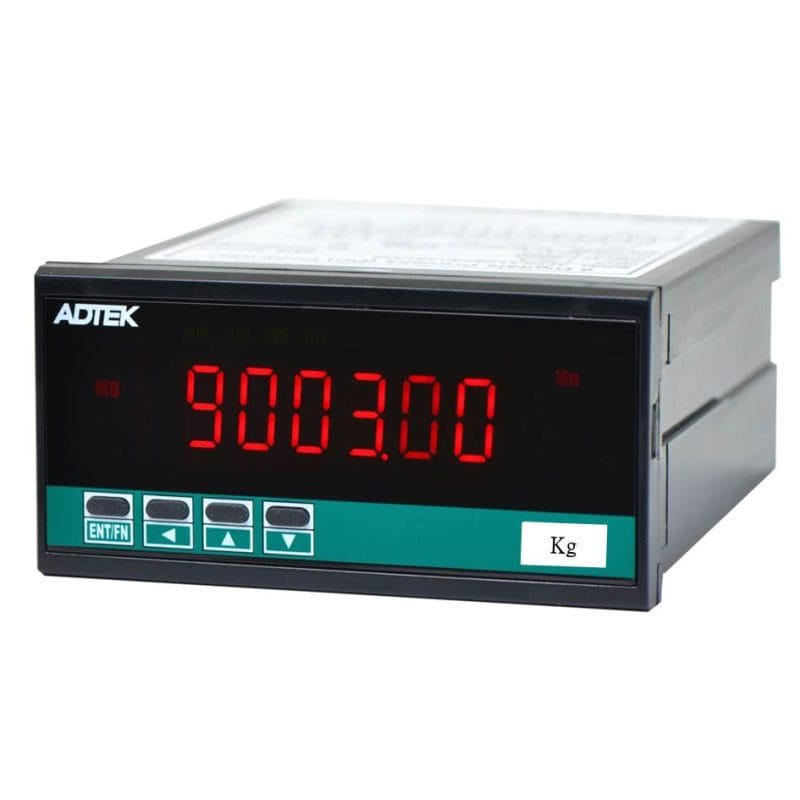
We had an enquiry from a customer setting up a filling line who needed a weight display that could also control the fill – start and stop the feed, and flag when the weight was over, under, or within tolerance. They asked for “a weighing controller” without being too specific on the outputs, since they weren’t sure what was actually available.
This looks simple, but a weighing controller like the ADtek A6-SG needs to be configured around your actual control sequence, not just wired in and left. You get up to 4 relay outputs and 4 external control inputs, and each relay can be individually set for feeder, discharge, peak-hold, or Hi/OK/Lo alarm duty, in one of 7 control modes – so we would need to know your fill sequence (for example: fast feed, slow feed, cut-off, then a settling check) before we can confirm which relay functions you need. On the input side, the 4 control inputs can be wired to terminals or triggered from the front keys, for zero, tare, gross, net, or weighing start/end. There are also two calibration methods – standard mV input, or keying in your load cell’s rated output (mV/V) or a known counterweight – so we’d also confirm which calibration approach your team is set up to use.
In actual application, the A6-SG takes a load cell signal directly (-1~35mV range, 0.3μV/D resolution), with a 24-bit A/D converter and a 6-digit display, and the sampling rate can be set from 6.25 to 100 times per second depending on how fast you need the reading to settle. It has a tracking zero and tracking stable function at the programming level, so the reading can be tuned to suit a shaking or vibrating scale platform. RS485 (Modbus RTU) communication and re-transmission output are available as options if you need to log the data or feed it to a PLC/SCADA system. It’s commonly used on filling machines, mixing machines, weighing/batching lines, and force-testing equipment.
From our experience, before we quote this, we would normally check your load cell specification, your fill/control sequence (how many relay functions you actually need), your calibration method, and whether you need the RS485 communication option. Hope this helps.